

A high-assurance transaction platform does more than verify identity at enrollment—it transforms how organizations secure their most critical workflows with verified presence and multi-biometric authentication. The PresenceID™ Identity Station leverages advanced biometrics and trust infrastructure meeting IAL3/AAL3 standards to authenticate, authorize, and witness high-value transactions across financial services, government benefits, and credential management.
The same hardware, biometrics, and trust infrastructure that establish an identity can authenticate, authorize, and witness a far broader set of workflows.
When most organizations think about an identity station, they picture a single moment: a person stands in front of a unit, proves who they are, and walks away with a credential. That moment matters, but it represents a fraction of what the station is built to do.
At NextgenID, we designed the PresenceID™ Identity Station as a high-assurance transaction endpoint. Identity proofing and credential issuance are the foundation, not the ceiling. The same hardware, biometrics, and trust infrastructure that establish an identity to IAL3/AAL3 standards can authenticate, authorize, and witness a far broader set of workflows, across government and commercial verticals, and across every population an organization serves: employees, contractors, businesses, consumers, and citizens.
One high-assurance transaction platform, many transactions
The reason a single station can do so much comes down to what it actually verifies. Each PresenceID™ unit can confirm a person’s identity at the highest assurance levels and support two- and three-factor authentication, including multi-biometric authentication across face, iris, and fingerprint. That capability isn’t reserved for enrollment. It can anchor any transaction where the cost of getting identity wrong is high, and as remote, unwitnessed channels grow easier to spoof, the list of those transactions keeps getting longer.
Consider how often an organization needs to be certain, beyond reasonable doubt, that a specific, verified person is present and consenting at a specific moment. Once you start counting, the use cases multiply quickly:
- High-value banking and financial services events. Opening new bank or financial services accounts, approving a large financial transfer, establishing an authorized signer, and changing ACH payments information
- Attestation and witnessing. Online mortgage closings, e-Notary services, establishing wills and trusts, voter registration, requests to release medical records/other HIPPA covered transactions
- Benefit and entitlement verification. Applying for or maintaining access to Federal State, and Local government benefit programs, like Social Security, Medicare/Medicaid, VA Services, Unemployment Insurance, Workers Compensation, SNAP, TANF, WIC, and Child Care
- Access and physical security events. Binding a verified identity to a facility access decision, a visitor check-in, or a privileged-area entry, with biometric proof rather than a transferable badge.
- Crypto account management. Binding high-assurance, multi-biometric verification to sensitive digital-asset actions, account opening and recovery, wallet or key re-binding, large transfers, and step-up authorization, where a self-asserted login or a single device is too weak to protect the value at stake.
- Credential lifecycle management. Reissuance, suspension, recovery, and re-binding of a lost or compromised credential can all be performed at the station with the same rigor as the original issuance.
- Periodic re-verification. Reconfirming identity at recurring intervals for high-trust roles, vendors, or program participants.
The common thread is assurance. Wherever a workflow currently relies on a weaker proxy, a self-asserted form, a knowledge-based question, a shared password, the station offers a higher-confidence alternative grounded in verified presence.
A smarter tier in a layered service-delivery model
Most organizations deliver services across a hierarchy of channels, and the channel they have leaned on hardest is now the one under the most pressure. Understanding why is the key to seeing where a high-assurance station fits, and why that role has never mattered more than it does today.
For years, the strategy was simple: push as much as possible to the online channel. That strategy is now collapsing under AI. Generative tools have made synthetic identities, deepfaked documents, voice clones, and convincing account-takeover attempts cheap and scalable, exposing the online channel for what it has become: a remote, unwitnessed interaction that organizations can no longer trust. The weaknesses were always there; AI has simply made them trivial to exploit at scale. As that trust collapses, more transactions are being pulled back out of the online channel and routed to where a human can be certain of who is on the other side: the appointment-based, in-person session.
This is colliding with a hard reality, especially in government. The surge in transactions that now require in-person handling is arriving at the very moment that many agencies are reducing both facilities and staff. Offices have been consolidated or closed, counters are understaffed, and appointment backlogs stretch for weeks. The channel organizations are falling back to is shrinking just as demand for it climbs, and constituents feel the result as long waits, long drives, and services that are effectively out of reach.
That gap between “can no longer be trusted online” and “there is nowhere convenient to do it in person” is exactly where the NextgenID Identity Station fits. By routing the displaced transactions to a station or to the PresenceID™ Network, an organization relieves the burden on both ends at once: the online channel sheds the interactions it can no longer safely carry, and the strained in-person counter is spared the transactions a station can handle on its own. Clients gain on every axis that matters:
- Higher assurance. Every routed transaction is completed with multi-biometric, verified-presence assurance the online channel can no longer guarantee, neutralizing the AI-driven fraud that is eroding remote trust in the first place.
- More locations, greater availability. A station isn’t bound to a single office’s hours, headcount, or address, so service reach expands precisely when an agency’s own facility footprint is contracting.
- Less time, money, and effort. The station automates the assurance work that previously required dedicated personnel, lowering cost per transaction, shortening constituent wait times, and freeing scarce staff for the genuinely complex cases that need them.
Used this way, the station becomes the high-assurance core of a layered model: it absorbs the growing set of transactions the online channel can no longer be trusted to carry, while scarce in-person resources are reserved for the true exceptions. The weak, increasingly exploited online channel stops being the default for anything that matters, and verified presence takes its place.
The reach this unlocks is the part worth sitting with. Imagine a federal, state, or local government entity able to extend the very highest assurance to its business and citizen constituents, anywhere in the world there is a NextgenID Identity Station, without building or staffing a single new office. The same assurance an agency could once only provide inside its own walls now travels to wherever its constituents are, on a footprint that scales nationally and globally.
Self-service, assisted, or observed on the same unit
A key reason the NextgenID Identity Station works as that middle tier is that it doesn’t force a single service model on every user or every transaction. The same unit flexes across three modes, and the right mode can be chosen by the user’s needs or required by the assurance level of the transaction:
- Pure self-service. A user can walk up and complete the entire workflow on their own, start to finish, with no staff involvement. For the many people and transactions that need only the station’s automated assurance, this is the fastest and lowest-cost path.
- On-demand remote assistance. If a question comes up mid-workflow, the user can be connected immediately to a remote agent, live, in context, without leaving the session or rebooking an appointment. Help is available the moment it’s needed, then the user continues. This captures people who would otherwise abandon a self-service flow and fall back to a costly in-person visit.
- Remote observation for higher assurance. For transactions that demand it, the workflow can require a remote agent to observe the session in real time, raising the assurance level by adding live human oversight to the station’s automated and biometric checks. The user still uses the same unit in the same place; the transaction simply carries the additional weight of witnessed presence.
Crucially, these aren’t three different products or three different locations. They are three modes of one station. An organization can let users self-select assistance when they want it, while reserving mandatory observation for the specific high-stakes transactions that warrant it, matching the level of human involvement to the risk of each transaction rather than over-staffing every interaction or under-protecting the sensitive ones.
The same strength, wherever your people are
That global reach isn’t a single product; it comes from three deployment paths an organization can combine to put high-assurance transactions wherever its people happen to be:
Deployed units across your enterprise. Stations installed at government facilities or commercial sites become permanent, high-assurance transaction points your workforce and customers can use for any supported workflow, not just initial enrollment.
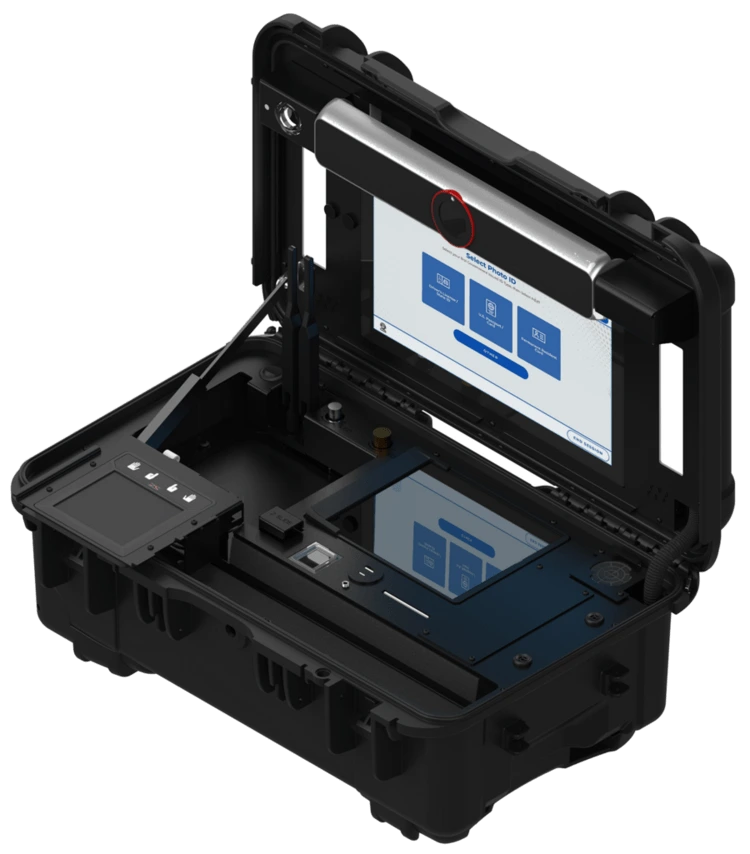
Mobile Identity Stations in the field. For mass enrollment events, remote sites, field operations, or populations that can’t easily travel to a fixed location, mobile units bring the full capability set, including multi-biometric authentication, directly to where people are.
The nationwide PresenceID™ Network. Organizations that don’t want to own and operate hardware can route their people to PresenceID™ Network locations, reaching a shared, professionally operated footprint that scales nationally without any capital outlay of their own.
A single organization can mix all three: fixed units for daily operations, mobile units for surge and outreach, and the Network for reach beyond its own footprint. The assurance level doesn’t change based on where the transaction happens, only the convenience does.
Why this matters for strategy, not just operations
Treating the identity station as a single-purpose proofing device leaves most of its value on the table. Treating it as a high-assurance transaction platform reframes the investment entirely. In a world where remote channels can no longer be trusted on their own, the unit you bought to issue credentials becomes the most defensible way to authorize your most sensitive actions, witness your most important agreements, and re-verify your highest-trust relationships.
For government agencies, that means fraud-resistant, in-person assurance for benefits, licensing, access, and constituent services. For commercial enterprises, it means a trusted endpoint for high-value transactions, workforce and contractor lifecycle events, and customer interactions where certainty is worth the step-up.
Identity proofing is where the relationship starts. The NextgenID Identity Station is built for everything that comes after.
To explore how NextgenID Identity Stations and the PresenceID™ Network can support high-assurance workflows across your organization, contact the NextgenID team.


